
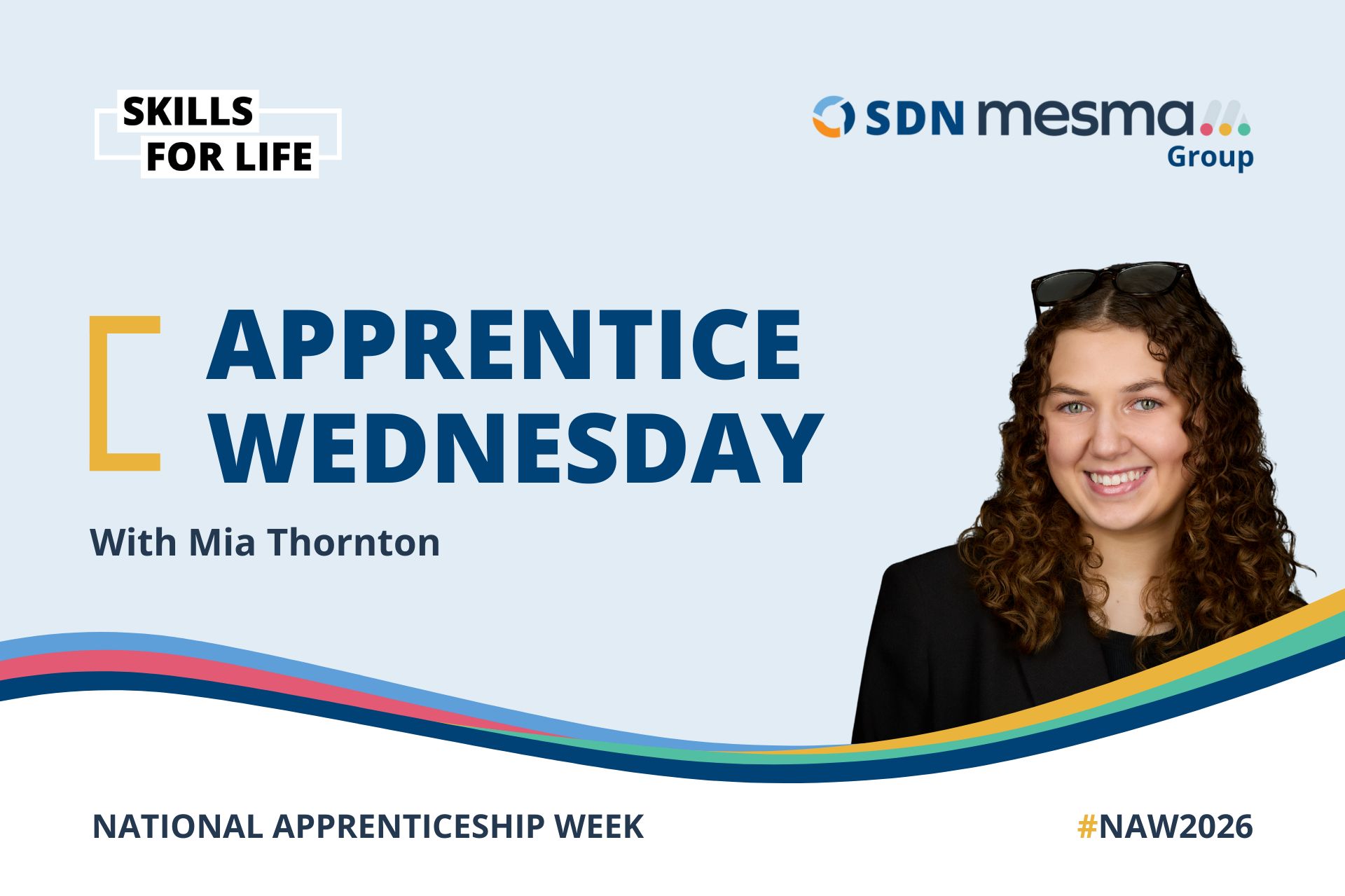
For National Apprenticeship Week, we spoke to Mia Thornton, Marketing Executive at SDN Mesma Group. Mia completed her Level 3 Marketing Apprenticeship at 19, just before joining SDN Mesma Group in November 2025.
Q: You’ve recently moved from being an apprentice to a full-time marketing role. What changed the most for you?
I think the biggest changes are the time that you have to focus completely on your role and the level of ownership. When you’re an apprentice, you’re balancing your day-to-day job alongside your apprenticeship work. Once you’re no longer an apprentice, you’re fully focused on your role.
You also get more independence. When you’re an apprentice, you’re still learning and building your skills, so it’s harder for people to give you full ownership of tasks. As a qualified marketer, there’s more trust in what you’re doing and more say in how things are done. That’s been a big change for me, and it’s something I really enjoy.
Q: Do you think people treat you differently now that you’re no longer an apprentice?
Yes. I think it depends on the company, but generally when you’re an apprentice, you’re seen a bit like a student. You’re new to the world of work, so people are naturally more cautious about giving you responsibility.
Once you’ve completed your apprenticeship and can say, “I’m a qualified marketer,” people trust you more. They know you’ve done the learning and the work, and that gives you more independence. That’s been a really positive change for me.
Q: If you’stayed in full time education, do you think you’d be in the same position now?
I don’t think so. If I’d gone to college, I’d probably be at university now, doing a marketing qualification. With a university route, you often have the qualification but not the experience.
When you leave college or university, you’re competing with other people who have the same qualifications. Apprenticeships give you real work experience. Things like working with stakeholders, managing a 9–5 job, and understanding professional expectations. Those are things you don’t fully learn in education.
Also, as an apprentice, you must manage your learning time, meet deadlines, and balance different responsibilities. That experience makes a massive difference when you move into a full-time role.
Q: Was there a moment when you realised your apprenticeship had really prepared you for this job?
Yes – I think it was when I realised how comfortable I felt speaking to different people. Through my apprenticeship, I learned to communicate professionally with everyone, whether that’s a CEO, a client, or someone at my level.
You learn how to judge when it’s the right time to speak to someone, how to prioritise work, and how to handle day-to-day working life. Those are things you can’t learn at school, college, or university; you only learn them by being in a work environment.
It also taught me things like managing my own diary, taking breaks at the right time, and understanding that if someone is busy, you might need to wait or find another solution. That confidence came directly from my apprenticeship.
Q: How did the apprenticeship help you develop technical marketing skills?
One of the biggest differences is that as an apprentice, you’re working with real clients. At college, you can guess who your audience might be, but you don’t know them. In an apprenticeship, you’re working directly with the people and organisations you’re trying to reach.
That makes a huge difference to my technical skills, using the right tone of voice in social media posts, writing blogs and emails and designing graphics. You understand what your audience wants to see because you work with them and build relationships.
You also learn by doing. You might know the theory from college, but with an apprenticeship, you’re applying it by running campaigns, creating content, and working on events. That builds confidence, because you can say, “I’ve done that,” not just “I’ve learned about it.”
Q: What about the lifestyle side of working compared to being in education?
It’s very different, but in a good way. One thing that surprised me was holidays; you can choose when you take time off instead of being told. I liked that freedom.
With work, you also know that once the day finishes, you’re usually done. At college or university, you might finish early but still have assignments to do in the evening. The structure of working life really suited me.
Q: Why did you become a North East Apprentice Ambassador?
At school, I knew almost nothing about apprenticeships. I thought they were mainly for labour-based roles, and marketing, HR, or teaching apprenticeships were never really talked about. I went to college for two months after leaving school and hated it. I didn’t think there was a way out until I did my own research and discovered apprenticeships. I don’t think young people should have to go through something they don’t enjoy just to realise what they want to do.
As an Apprentice Ambassador, I want to raise awareness and show young people that apprenticeships are a real option. You can still learn, build a career, earn money, and gain experience without the debt. Being part of the Ambassador Network has also been amazing because you meet other apprentices, share experiences, and support each other. It’s reassuring to know you’re not going through it alone.
Q: What’s next for you?
I’m planning to start the Level 4 Marketing Executive Apprenticeship in the new academic year. I love working in marketing, and I want to keep building my skills and knowledge. The Level 4 is more strategic, which fits perfectly with my role and where I want my career to go. One of the things I love about apprenticeships is that learning never stops. You can keep progressing, developing, and growing, and I’m excited to continue that journey.
Q: Finally, in one sentence, what impact has your apprenticeship had on you?
Confidence! The opportunities I’ve had and the trust I’ve been given have made me confident in what I do and in where I’m going next.
Follow us on LinkedIn to see the rest of our National Apprenticeship Week 2026 content.